Updates: 06/06/25
The Case

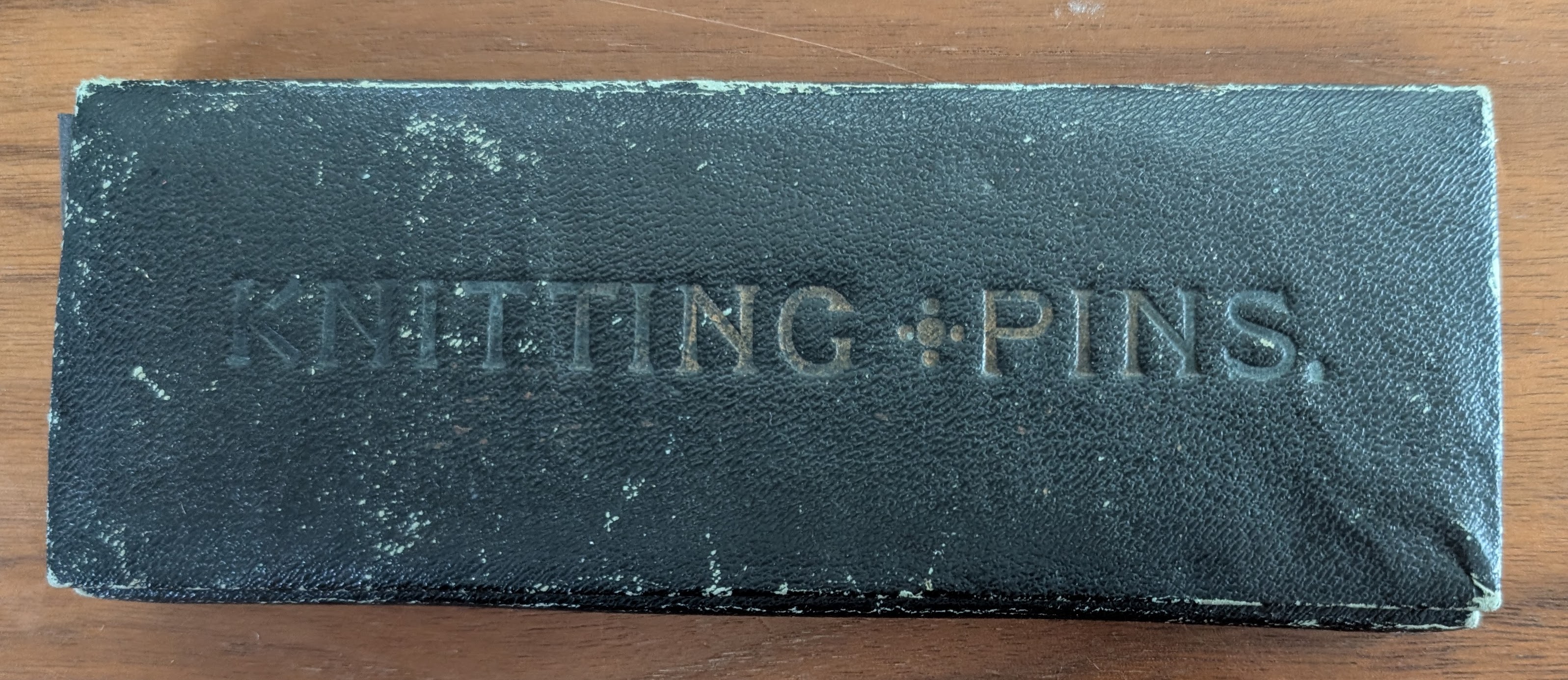
I have a new and exciting find for my display case! It's kinda beat up, some of the needles are missing, and they need some sort of rust removal and then rust prevention.
But, I'm not worried about the case breaking, the labels on the inside are pristine, and almost all of the small needles are actually in it. My quest for antique tiny knitting needles really hit a dead end a while back, I think because they're so easy to lose, so I was super excited to find this.

It holds sizes 11-19 and was probably intended to be able to hold sets of five dpn, at least for the smaller sizes.
While the needles aren't in the best of shape, most of them still are in the case.


| Size1 | Metric Size US Size | Number of Needles Remaining |
|---|---|---|
| 11 | 3.0 mm 2 1/2 | 4 |
| 12 | 2.75 mm US 2 | 1 |
| 13 | 2.25 mm US 1 | 1 |
| 14 | 2.0 mm US 0 | 4 |
| 15 | 1.75 mm US 00 | 4 |
| 16 | 1.65 mm – | 5 |
| 17 | 1.5 mm US 000 | 4 |
| 18 | 1.25 mm US 4/0 | 4 |
| 19 | 1.0 mm US 5/0 | 4 |


UPDATE: I think this isn't missing as many needles as I thought it was. When looking at this advert from the time period (this is targeting buisness owners rather than the general public) with the exception of No 35, all of the needles are sold as 1/4 gross of each size (a gross is a dozen dozen or 144). I think that is the number for individual needles rather than sets and a gross is divisible by 4 but not 5.
This would mean that all sets except for 12 and 13 are complete. Most of the holders seemed full as the needles wouldn't just slip out but that also could be due to the rust.

I have full sets of metal dpn in US sizes 000 to 0, I do plan on seeing if all five fit in their relevant holder at some point. I also have a set of bamboo 6" US 2 dpn that I will test as well. If the full sets of 5 fit I will probably exchange them as I'd like to use this case and maybe the needles.

My main hesitation on using the needles is that because I work with small needles frequently, I would have a decent amount of exposure to the metal.
While the needles are often described as steel, I don't have the technology2 to actually test what metals are present and due to the time period there is a high probability of at least some lead in them, although Europe put in safety measures surrounding the use of lead much earlier than the US. I also should check to see if my local ACE hardware has cheaper test strips. After some further digging I'm not too worried about the lead, any article that I've found about the safety of historical knitting needles has stated that it's not too big of an issue and that needles were made with stainless steel.

I am also just sensitive to metal in general, so even while I'm cleaning the needles my hands are having a slight reaction to them although that could be the rust rather than the metal itself.
If you don't want to read my chemistry ramble you can jump to the history section or the cleaning details from what I actually did.
Cleaning
I have moved on to the more tedious part: actually cleaning them.
I don't plan on doing too much to the case itself other than wiping the outside off with an antibacterial wipe and seeing if there is any leather conditioner around the house (I'll need to do some reaserch on if that's a good idea or not).
Part 1: Chemistry
For the rust removal it is now chemistry time!
I started with a basic vinigar bath, aka diluted acetic acid. I used what was in my house which was 5% acetic acid. While I have seen people use up to 9%, they also normally dilute it at a 1:1 ratio with water which kinda defeats the purpose of the higher concentration.
You can find higher concentrations, if you know where to look, part of me still thinks I'm student lab manager at my college (I graduated two years ago...) and was thinking about what dilution I would do with pure acetic acid (okay it's >99% so close enough) or if I should do a speed run with a small ammount of the pure stuff the next time I went to work.
The highest concentration you could get without winding up on some government list is glacial acetic which is about 30% from amazon.
Although Millipore Sigma (the walmart of chemical companies) will let you buy the pure stuff. PLEASE DON'T DO THIS! It is incredibly dangerous and this can't be just dumped down the sink, it has to be neutralized and/or disposed by the propper authorities. You do NOT have the tools at home to do this.
Part 2: The Process
For those of you who wan't to skip the why and go straight to the how of cleaning. First I took some household vinegar (5%) and paper towel and just tried wiping the rust off. I leared pretty quickly that this wasn't going to work.
To keep all of the needle sets together I wrapped them in paper towel, making sure that none of the needles were making metal to metal contact. This worked when it came to making sure the whole needle was soaked while the sets stayed together. I left this overnight soaking in some slightly watered down vinegar (probably close to 3.5%).
Then, rather than unwrapping the wet paper I just punched through with the tip of the needles and pulled them out. This did a good job of removing a lot of rust while keeping the rust contained.
However, this didn't remove anywhere close to all of the rust. After removing as much rust as possible I put the needles directly back into the container, I'll need to sort them by size but this is going to ensure that the whole needle is soaking. I also am able to check if the reaction is working, both by seeing if there are rust particles in the water and if there are bubbles along the sides of each needle.
The History, or The Lack Thereof
Unfortunately, I have found almost no information about the case itself. It basically doesn't exist on the internet, aside from a single ebay listing which only tells me that they had a nice maroon option too.

I can say that at minimum this case was made before 1900 as my knitting pin case proudly states 20 gold & prize medals but The Women's Exhibition from 1900 lists them as having 23, so it predates this publication.

I also think that this was brought to the US by an immigrant/person rather than an importer/ company.

I found this is Colorado Springs at a second hand art store, but the second label showing the seller, Robert Cullen, has an address in England. Had it been originally sold in the US I would have expected the address to be here as it's not the company address.

I haven't been able to find more information on the seller specifically due to the Twilight series. Seriously, I'm not looking for sparkly vampires, I'm looking for a dead and buried white guy.

This lack of information really stems back to women's work (sewing, knitting, crochet, ect.) and media related to it not being seen as important enough to keep in an archive or not prioritized for digitization.
W. Bartleet & Sons sold two main products: needles (both sewing and knitting) and fishing hooks. This divide between womens and mens in terms of importance is showcased here.

On archive.org, which now that I have graduated college is one of the only digital archives I have access to, there are a number of references to W. Bartleet & Sons, 146 to be exact.
18 were written after 1930
26 are lists of merchants, patents or other related directories that don’t have any detailed info.
5 are lists of exhibits from various exhibitions (1 duplicate)
6 are copies of Rod in India about fishing in India published in 1897
At least 6 are duplicates of other books not already mentioned
Amongst them there are four references for W. Bartleet & Sons needles:
The Womens' Exhibition from 1900 lists the company as having an exhibit.
The St. Louis Post-Dispatch 1904-04-07 Vol. 56 issue 230 has a very small advert for 2000 papers of needles.
The History and Description of Needle Making by Michael T Morrall, published in 1862 has references to the company but no illustrations or lists of specific products.
The Dry Goods Review and Mens Furnisher from 1906, is a book of Canadian advertisements, mainly targeting wholesale shoppers. It describes shops in Canada (mainly Montreal and Toronto), their address, and what they sell in a decent amount of detail.

They do reference W. Bartleet & Sons but only as an advert for their "Archer Brand" Sewing Needles.  It does also give the name of the distributor in Canada.

As I dive more into the historical (1850-1920) manuals surrounding fiber arts it has been quite difficult to find adverts for the tools and materials referenced in the instruction manuals. They often aren't illustrated and are burried in with many other things.

Even in catalogues that are described as illustrated, the knitting needles rarely are.
One of the only catalogues that has the knitting needles and crochet hooks illustrated is the Carson Pirie Scott & Co Wholesale Dry Goods Illustrated Catalogue of Staple and Fancy Notions 1893-1894, bassed out of Chicago.
They really do have everything illustrated, 12 pages of smoking pipes, 3 pages of corkscrews, and 7 pages of specifically German accordions. In and amongst them there are 4 pages of illustrations of knitting needles and crochet hooks.


And this isn't because the accordions are new or rare or need more detail shown, there are nine pages of illustrated scissors, over six pages of illustrated sewing needles, but the knitting needles have one page and crochet hooks have three pages, although two are targeted towards business owners rather than individual customers.

If I find any more information I will update this although I doubt I will, at least online.
A Few Small Updates
Cleaning the rust off is going to be more difficult that what I assumed. I had to take some fine grit sand paper to the ends of some of the needles due to the oxidation. I'm unsure how long it will take me to fix given that I start a new job in two days.

The case does fit my modern needles and each space does fit 5. It looks a bit overcrowded but if there are only four in the space they fall out.

I did find an unillustrated listing (highlighted in blue) for a similar case, just with fewer needle sizes in this Anthony Hordern's Sale Catalogue from 1905. This was a store in Sydney, Austrailia.

A Few Small Updates: Part 2
 While I'm still going to keep all of the original needles, I am planning on replacing them for my own personal use. The rust did some serious damage to the ends which would make them difficult to knit with.

For the size 11 (US 2.5/3.0mm) only 4 needles fit in the spot, I can fit a fifth one in but it's so tight it would do damage if I left it in there long term.


At this point I have four sets of HiyaHiya 6" dpn for sizes 11, 14, 15, and 17. I have a package of Boye 7" dpn sizes 000-1 on the way so I'll see how I like those in comparison, they were super cheap so they'll probably bend easily, but they are the same length as the originals.


As for the originals, I'm planning on only working on restoring the smaller sizes as they will be much harder to replace, are less damaged, and I've been able to buff/ sand off the damage.
I have finished with the No 19 for now and am switching over to using them on a current project. The set I was using is 8" and I didn't realize how irritating using such long needles on a small project would be when working in the round.

Despite the discoloration on the needles from where I couldn't complete sand off the damage, I haven't had any issues with using them.
But knitting pins is a very accurate descriptor, one of them punched a hole straight through my knitting bag! It's fabric with some heavy interfacing so no long term damage but still.

- I’m assuming this is using the Walker’s Gauge, the predecessor to the old UK sizes, they look like they’re the right sizes ↩︎
- There are low cost ways to check for lead, I have a Bachelors in Chemistry so my first thought is using a special scanner to look at the metal content breakdown, but that isn’t actually necessary ↩︎
Leave a Reply